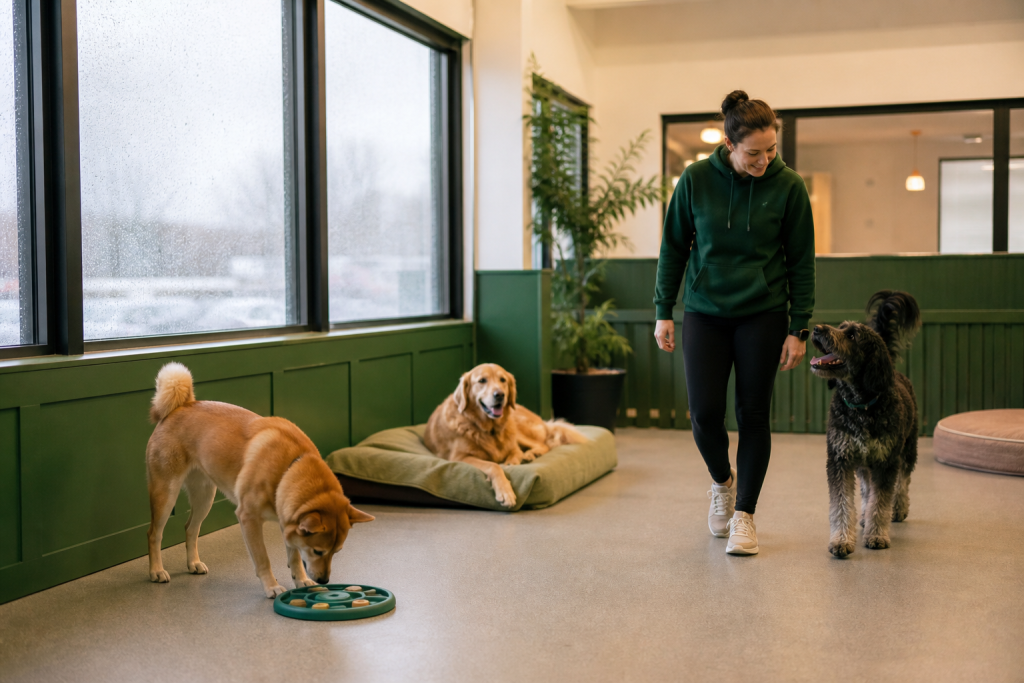
‘Was he good?’ is a natural question at pickup, but it can produce an answer too broad to help with the next visit. A more useful conversation asks what your dog actually did and whether there is something you should clarify before returning.
Pet Care Plus describes its approach on the dog daycare page. Ask the team which observations it can share and how updates are normally provided; do not assume a particular report, photograph, or messaging schedule is included.
Decide what you want to understand
Choose one or two questions relevant to your dog rather than asking for a minute-by-minute account. If arrival has been difficult, ask about the transition after you left. If you are discussing a care arrangement, ask whether the team has information that should shape the next conversation.
A concrete question could be: ‘Did the arrival note I provided help, or is there something else you need from me?’ This invites an observation and an action. It does not ask the team to label your dog’s personality from a single day.
Before pickup, identify the question behind your question. You may want to know whether the arrival note was useful, whether the dog settled into a familiar routine, or whether the team needs updated information before another visit. Those are more specific aims than collecting a general rating of the day. A clear purpose makes it easier to ask something the team can answer with an observation.
Choose one or two priorities rather than preparing a long interview for a busy collection period. If the question needs more time, ask when and how to discuss it. You can be interested in your dog’s day while also recognizing that the person at the desk may need to consult another team member. A useful update comes from the relevant observation, not from insisting on an immediate answer to every question.
Ask what happened before asking why
When a description is unclear, ask what was observed. Words such as energetic, quiet, or social can mean different things. Knowing the situation gives you a better starting point than assuming the adjective explains why the dog behaved that way.
- What situation was being described?
- Was this new or similar to previous visits?
- Is there a care detail the team wants updated?
- Should anything be discussed before another booking?
- Who should answer a question that needs more time?
An observation describes something seen or recorded. An explanation proposes a reason. If you hear that your dog was quiet, ask what that meant in the situation. Was the person describing a particular part of the day or a comparison with earlier visits? Avoid immediately deciding that the dog must have been unhappy, tired, or unwell based on one broad word.
The same principle applies to positive descriptions. Energetic or sociable may be useful starting points, but they do not explain every interaction. Ask for the detail that relates to your practical question. If the observation raises a health or significant behaviour concern, involve the appropriate professional. Daycare staff can share care observations; that is different from diagnosing the cause of a change.
Use questions that have an observable answer
Try asking whether a particular instruction was clear, whether an arrival detail needs updating, or whether there is a practical point to discuss before the next visit. These questions focus on information and action. They do not require a staff member to summarize your dog’s personality or compare the dog with every other animal at the resort.
For example, “Was the new collector information clear?” and “Is there anything you need from me before next week’s visit?” have a concrete purpose. If your interest is about the dog’s response to a particular part of care, explain that context. Ask what can be shared through the resort’s normal update process rather than assuming a special report or photograph is included.
Give the team current household context
Tell the team about a changed routine, a new pickup person, or a relevant instruction from your veterinarian. Keep the description factual: what changed and when. This gives context without asking the team to infer a medical or behavioral cause.
Your observations at home and the team’s observations at daycare describe different settings. They may both be useful without matching perfectly. If you are concerned about health or a significant behavior change, consult the appropriate veterinary professional.
Tell the team about relevant changes before or during the visit through the accepted route. A changed collector, a different morning routine, or a current veterinary instruction may affect the care conversation. Keep the information factual and distinguish what happened from what you think it means. A new work schedule is a fact; a claim that it has caused a particular behaviour may need assessment.
Do not expect the team to reconstruct the household context from social-media posts or an unrelated message. Identify the dog and the visit date, then explain the detail that matters. Ask how the record should be updated if the change will continue. A useful daycare update depends partly on the team having accurate information from the owner.
Keep home observations separate but connected
What you see at home and what the team sees at daycare happen in different settings. The accounts may both be accurate without being identical. Share a relevant observation without treating it as proof that the daycare description is wrong. Ask whether there is additional context that would help you understand the difference.
Avoid assuming that one evening at home tells the entire story of a daycare visit. Record what you noticed, when it happened, and whether it continued. Seek veterinary advice for health concerns rather than using an informal comparison to decide the cause. The purpose of comparing observations is to ask a better question, not to force every setting into the same description.
A worked example of a better pickup question
Imagine an owner who hears that a dog was “a little different today.” The owner could respond by assuming something serious happened or by dismissing the comment as too vague. A more useful response is to ask what was observed, during which part of the day, and whether the team needs an updated care detail or a follow-up discussion.
The owner explains a relevant change in the morning routine without presenting it as a diagnosis. If the conversation needs more time, the owner asks for the accepted follow-up route. This example does not establish what the dog’s behaviour means. It shows how a vague description can become a factual exchange with a clear next step.
Understand the limits of photographs and short messages
A photograph captures a moment. It cannot show the entire day, every interaction, or the reason for a particular expression. Enjoy an update for what it provides, but do not use one image to make a medical or behavioural judgment. If a detail concerns you, ask the team about the context rather than relying on an interpretation made from the picture alone.
The absence of a photograph is also not evidence of a problem. Ask what the resort normally provides and how questions should be raised. Do not assume that another owner’s update establishes a guaranteed schedule or service for your visit. Clear expectations about communication make the experience easier to understand.
Make a follow-up message easy to answer
Include the dog’s name, the visit date, and the specific observation or question. If the message follows a pickup conversation, summarize the point you are clarifying. Avoid adding several unrelated requests in the same paragraph. The person receiving the message should be able to identify which visit and which part of the discussion needs attention.
State what answer would help. You might need to know whether a record should be updated, whether a care detail needs confirmation, or when a longer conversation can happen. A clear request is easier to route than a message saying only that you are worried. If the concern is urgent or medical, use the appropriate professional contact rather than waiting for routine marketing or social-media channels.
Keep a short history without grading every visit
Note the date, the observation shared, and any agreed follow-up. A short history makes it easier to explain what you are asking about next time. Avoid assigning a score to each day or treating one positive or difficult moment as the full picture.
If you are returning after a long gap, use the restart checklist to update the underlying care information as well. A useful update depends on a current record.
A few dated notes can help you notice recurring questions. Record the observation shared, the context, and any agreed follow-up. Avoid turning the record into a daily score for whether the dog was good. Scores can hide useful detail and encourage comparisons that do not reflect the individual animal’s care needs.
Review the notes when something changes or before discussing a future arrangement. If a question has been resolved, record the answer and remove obsolete instructions from the current care note. A concise history supports continuity. A large collection of unexplained impressions can make it harder to identify the practical issue you want the team to address.
Ask who should handle a detailed concern
A busy collection period may not be the right moment for a lengthy discussion. Ask when a staff member can address a detailed question and which contact route to use. That is more practical than expecting a complex explanation while other pets are arriving or leaving.
Use the Pet Care Plus contact page if a follow-up is needed. Include your dog’s name, the visit date, and the specific question so the team can identify the context.
The person completing pickup may not be the person best placed to discuss a particular observation. Ask how a detailed question is routed and when a suitable conversation can happen. This helps the team find the relevant information without requiring someone to speculate. It also gives you a clear expectation about the next step.
Keep professional roles distinct. The daycare team can discuss care arrangements and observations. Veterinary questions need a veterinarian, and a significant behaviour concern may require the appropriate qualified professional. Asking for the right person is part of obtaining a useful answer, not a sign that the original question was unwelcome.
Use the update to improve the next handoff
After a useful conversation, identify the action you can take. It might be supplying a clearer collector instruction, updating a current record, or arranging a longer discussion before another booking. Keep the action proportionate to the observation. One comment should not automatically trigger a complete change in routine without understanding the context.
At the next visit, refer to the agreed update briefly. Confirm that the information is current and ask whether anything remains unclear. This closes the loop between the earlier conversation and the new handoff. The value of an update is not only hearing about the day; it is making the information easier to use for the dog’s ongoing care.
More questions about daycare updates
Is asking “Was my dog good?” wrong?
No. It is a natural opening. Follow it with a specific question when you need practical information. Ask what was observed or what the team needs from you rather than treating a broad description as a complete account.
Should I compare my dog’s update with another dog’s?
Different animals and visits can produce different observations and communication needs. Ask about your own dog’s context and the resort’s normal process. Another owner’s report does not establish what every visit should include.
Can a quiet evening prove daycare was too much?
A single observation does not establish a cause. Describe what you notice and discuss relevant concerns with the appropriate professional. Avoid making a medical or behavioural conclusion from one word or one evening alone.
What if I remember a question after leaving?
Use the accepted contact route and identify the dog, date, and question. A concise follow-up is easier to answer than an unexplained message. Seek prompt professional advice if the concern is urgent rather than waiting for routine follow-up.
What should I record for future visits?
Keep the date, the concrete observation, and the agreed action. Update the current care record when needed. The aim is a usable history that supports the next conversation, not a ranking of your dog’s daily performance.
Does a daycare update diagnose a behavior problem?
No. It describes observations in a care setting. Ask for the details, discuss the next practical step, and involve an appropriate professional when a concern requires assessment beyond daycare care.