
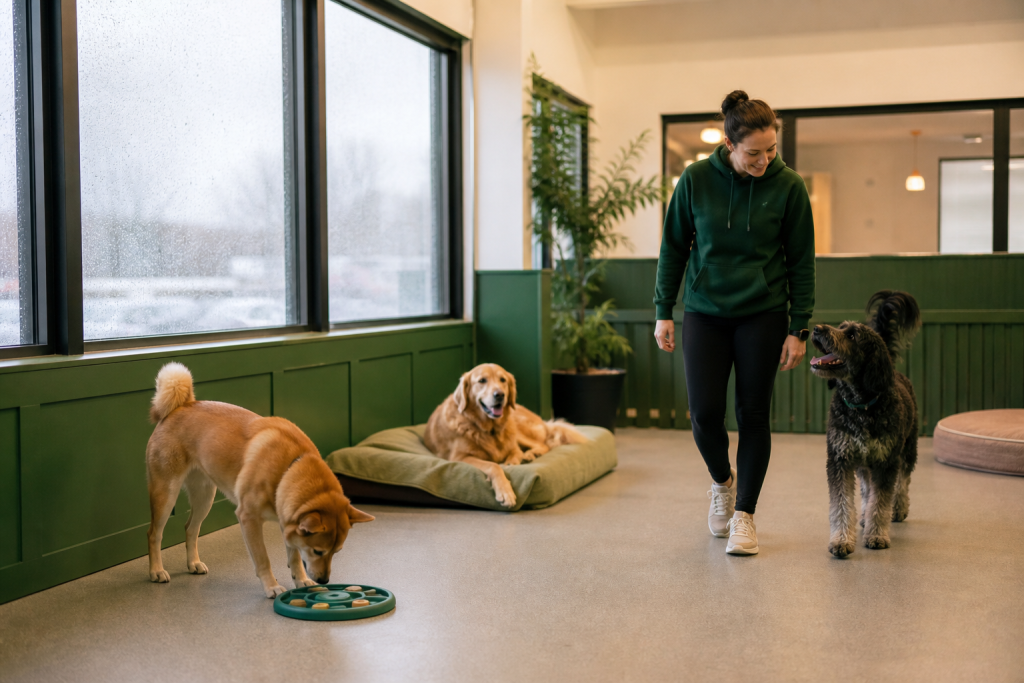
A Rainy Day Can Still Be a Balanced Day
Rainy-day dog daycare in Chicago should be about more than finding somewhere indoors for your dog. When sidewalks are wet, outdoor plans change, and a normal walk becomes shorter, pet parents still want their dogs to have a day that feels purposeful. A balanced daycare routine can combine supervised activity, thoughtful group placement, quieter enrichment, observation, and time to settle.
The important word is balanced. More activity is not automatically better, and an indoor day should not become hours of nonstop excitement. Dogs arrive with different ages, sizes, temperaments, confidence levels, and play styles. A thoughtful rainy-day plan responds to those differences rather than asking every dog to move through the same schedule.
Pet Care Plus provides dog daycare in Chicago at its West Loop pet resort. Dogs are placed in appropriate play groups based on age, size, and temperament, with individual and special-care options available for dogs who may prefer a quieter experience. That structure matters on any day, but it becomes especially visible when Chicago weather brings more of the routine indoors.
Why Indoor Daycare Still Needs Structure
An indoor playroom changes the environment, not the need for good judgment. Sound travels differently, dogs share closer visual space, and transitions can feel more noticeable than they do outdoors. A structured approach helps the care team manage the flow of the day and respond when a dog needs a change of pace.
Structure begins with suitable grouping. A young dog with an energetic play style may enjoy a different rhythm than an older dog or a dog who prefers brief social interactions. Grouping by age, size, and temperament supports a more appropriate match. It also gives staff a clearer way to observe how individual dogs are responding within the group.
The day should have recognizable phases rather than one long play session. Arrival and settling in, supervised social activity, lower-intensity engagement, rest, and calm pickup can all be part of the routine. The exact sequence may vary, but the principle remains the same: activity and recovery work together.
Morning Arrival: Starting With Observation
Rain often changes the energy of the morning before a dog reaches daycare. Some dogs have had a shorter walk. Others arrive damp, distracted by umbrellas and traffic, or more energetic because they spent extra time indoors. A clear check-in gives the team an opportunity to understand how the dog is presenting that day.
Pet parents can help by sharing relevant, non-medical observations. Mention whether your dog’s morning routine changed, whether breakfast was normal, and whether there is anything different about the dog’s ordinary energy or comfort. Health concerns belong with your veterinarian; Pet Care Plus is a boarding, daycare, and grooming resort, not a veterinary provider.
For a new daycare guest, confirm the current requirements before arrival. Pet Care Plus requires proof of current Rabies, DHPP, and Bordetella vaccinations for daycare and boarding guests. The resort requires the records but does not administer vaccines. Preparing documentation in advance helps the handoff stay focused and efficient.
Thoughtful Groups Matter More Indoors
Indoor daycare works best when play partners and group size reflect the dogs in the room. A compatible group is not simply a collection of dogs that arrived on the same morning. The team needs to consider age, physical size, temperament, and the way each dog engages with others.
Pet Care Plus offers multiple play areas and places dogs in appropriate groups by age, size, and temperament. This creates flexibility when one dog enjoys active interaction and another prefers a calmer pace. Individual and special-care options are also available for shy or low-key dogs, so group activity does not have to be the only possible experience.
Pet parents should resist judging daycare quality by how crowded or energetic a room appears for a few seconds. A busy-looking room is not necessarily a better room. The useful questions are whether dogs have suitable companions, whether staff are observing the group, and whether a dog can move into a quieter phase when needed.
Activity Does Not Need to Mean Constant Motion
On a rainy day, indoor activity can take several forms. Social play may be one part of the routine, but movement, attention, exploration, and lower-intensity engagement can also contribute. The aim is to give dogs an appropriate day, not to keep every dog moving without a break.
A dog who is constantly excited may have difficulty settling later. Conversely, a dog who receives no meaningful engagement may finish the day with the same pent-up energy that concerned the owner in the morning. Balance comes from observing the dog and alternating suitable activity with opportunities to pause.
This distinction is important when pet parents talk about wanting a “tired dog.” The better goal is a dog who has had a supervised, engaging day that fits the individual. Daycare should not promise a behavioral outcome, and no responsible article can guarantee exactly how a dog will act after pickup.
Rest Is Part of the Daycare Experience
Rest should not be treated as empty time. It gives a dog space to settle after social activity and helps the care team observe whether the current pace remains appropriate. In an indoor environment, planned quieter periods can also reduce the effect of constant sound and movement.
Different dogs rest in different ways. One may relax quickly, while another needs a gradual transition away from activity. A dog may prefer being near familiar staff, moving to a quieter area, or simply having fewer interactions for a period. The correct approach depends on the dog and the options available that day.
When evaluating daycare, ask how activity and rest fit together. A useful answer should explain the care model without promising that every dog’s schedule is identical. The goal is a structured routine with room for individual needs, not a rigid timetable designed for marketing.
Indoor Enrichment Should Have a Purpose
Enrichment is most useful when it supports appropriate engagement rather than creating novelty for its own sake. On a wet Chicago day, the care team may use indoor space and suitable activities to keep the routine varied. What matters is that the activity fits the dogs involved and remains supervised.
Pet parents do not need an exhaustive list of props to evaluate the experience. Ask instead how the team chooses an activity, watches participation, and recognizes when a dog would rather pause. A simple activity used thoughtfully can be more valuable than an elaborate setup that does not match the group.
The word “enrichment” should also not be used as a medical or behavioral promise. Daycare can provide supervised care, play, socialization, and engagement. It does not diagnose, treat, or cure anxiety, behavior conditions, or health concerns. Those questions should be directed to an appropriate professional.
Staff Presence Connects the Whole Routine
The value of structure depends on people who are present and paying attention. Pet Care Plus describes its resort as staffed 24 hours a day, every day of the year, so pets are never left alone. For daycare families, the most relevant part of that statement is a broader culture of on-site supervision and care.
On a rainy day, staff help guide transitions between arrival, group activity, quieter engagement, and pickup. Their role is not to force every dog to participate at the same intensity. It is to observe the dogs in front of them and manage the available care options.
Around-the-clock staffing is not a medical guarantee and should never be presented that way. Pet Care Plus is not a veterinary provider. It offers boarding, daycare, and grooming services in a purpose-built pet resort environment.
How Webcams Fit Into a Rainy Day
Pet Care Plus offers live webcam access so pet parents can view their pets remotely during a stay. That visibility can be reassuring when an owner is at work and wondering how an indoor day is progressing. It can also help families feel connected to the daycare routine.
A webcam captures moments, not the entire context of the day. Your dog may be resting, transitioning, or spending time outside the visible area. A short view should not be treated as proof that the dog has been inactive all day or as a complete account of every interaction.
Use webcam check-ins constructively. Review the Virtual Tour and Live Webcams information and confirm current access details with the team. If you have a genuine care question, contact Pet Care Plus through the normal communication path rather than trying to interpret a brief image without context.
A Rainy Day Can Introduce the Resort Routine
For some families, daycare is also a way for a dog to become familiar with the people, spaces, sounds, and transitions of the resort before a future boarding stay. That familiarity may make the setting less new, but it should not be described as a guaranteed method for changing behavior or eliminating stress.
If boarding is part of your future plan, tell the team. You can review Dog Boarding in Chicago and ask how the daycare and boarding paths connect. Keeping both services under one clear care conversation can simplify records and routine notes.
The decision should still begin with the individual dog. A social dog may enjoy the group routine. A shy dog may need a slower or more individual approach. A tour and direct discussion are more informative than assuming daycare is automatically right for every pet.
What Chicago Pet Parents Should Ask
Before booking, ask how dogs are grouped, how the team handles rest, which vaccination records are required, and what happens when a dog needs a quieter experience. Ask whether there is an introductory process for new guests and how current webcam access works.
For rainy days specifically, ask how the routine changes when outdoor activity is limited. The answer does not need to describe every minute. It should show that the team has a thoughtful way to balance supervised indoor activity and rest without treating weather as a reason for chaos.
Also confirm current drop-off and pickup instructions. Chicago traffic can become slower in heavy rain, so leave enough time for a calm handoff. If your schedule changes, call the team rather than arriving outside the expected plan without notice.
Preparing for Wet-Weather Drop-Off
Keep the arrival simple. Use a secure leash, allow extra travel time, and follow the team’s current instructions about belongings. If your dog is damp, let the team know rather than packing unrequested towels or accessories. Resort policies can change, so current instructions should guide what you bring.
Share any meaningful change in the morning routine. If the dog missed a usual walk because of the weather, that information may help the team understand the dog’s starting energy. Avoid turning ordinary observations into diagnoses; simply describe what happened.
If another person will handle pickup, confirm authorization and contact details in advance. Wet weather is not the time to build the handoff plan through a series of last-minute messages. A clear reservation record helps the team focus on the pet.
What to Notice After Pickup
At pickup, listen to the care team’s non-medical observations about the day. Ask about participation, rest, and whether anything should be considered for the next visit. This information is more useful than expecting one particular energy level from every dog.
Your dog may be ready to rest, interested in the home routine, or simply pleased to see you. None of these moments alone proves whether daycare was successful. Look for patterns over time and communicate questions with the team.
If you notice a health concern, contact your veterinarian. Pet Care Plus can share ordinary care observations but does not diagnose or treat animals. Maintaining that boundary keeps communication accurate and helps pet parents use the right professional resource.
Choosing a Balanced Daycare Routine
A rainy-day daycare decision should account for more than convenience. The location needs to work for the family, but the program also needs a clear approach to supervision, grouping, activity, rest, records, and communication. Those elements matter more than whether the forecast is sunny or wet.
Pet Care Plus is located at 350 N. Laflin St. in Chicago’s West Loop and provides dog daycare within its broader pet resort. Families can schedule an in-person tour by appointment or begin with the online tour.
When you are ready, use Book Now to choose the correct new- or existing-customer reservation path. For general guidance about keeping pets active safely, the American Veterinary Medical Association’s exercise guidance provides a useful veterinary resource; questions about your dog’s health or activity suitability belong with your veterinarian.
FAQs
Does Pet Care Plus offer rainy-day dog daycare in Chicago?
Pet Care Plus provides dog daycare at its West Loop pet resort. When weather changes the normal routine, care can continue in the resort’s available supervised environment with grouping based on age, size, and temperament.
How are dogs grouped during daycare?
Pet Care Plus places dogs in appropriate play groups based on age, size, and temperament. Individual and special-care options are also available for shy or low-key dogs.
Are vaccination records required for dog daycare?
Yes. Pet Care Plus requires proof of current Rabies, DHPP, and Bordetella vaccinations for boarding and daycare guests. The resort requires documentation but does not administer vaccines.
Can I view my dog during daycare?
Pet Care Plus offers live webcam access so pet parents can view their pets remotely during a stay. Confirm current access details with the team for your reservation.
Is Pet Care Plus staffed throughout the day and night?
Pet Care Plus states that its resort is staffed 24 hours a day, every day of the year, so pets are never left alone. This is an on-site staffing statement, not a medical or outcome guarantee.
How do I book dog daycare at Pet Care Plus?
Use the Book Now page to select the New Customer Reservation or Existing Customer Reservation path. You can also call Pet Care Plus at (312) 397-9077 with general questions.
Conclusion
Rain does not have to turn a dog’s day into either boredom or nonstop indoor excitement. A balanced rainy-day dog daycare routine uses thoughtful grouping, supervised engagement, quieter periods, observation, and clear communication with pet parents. Pet Care Plus gives Chicago families a West Loop daycare option with appropriate play groups, individual-care choices, webcam access, and connected boarding and reservation paths. Review Dog Daycare in Chicago or book a daycare day when the next wet forecast changes your plans.