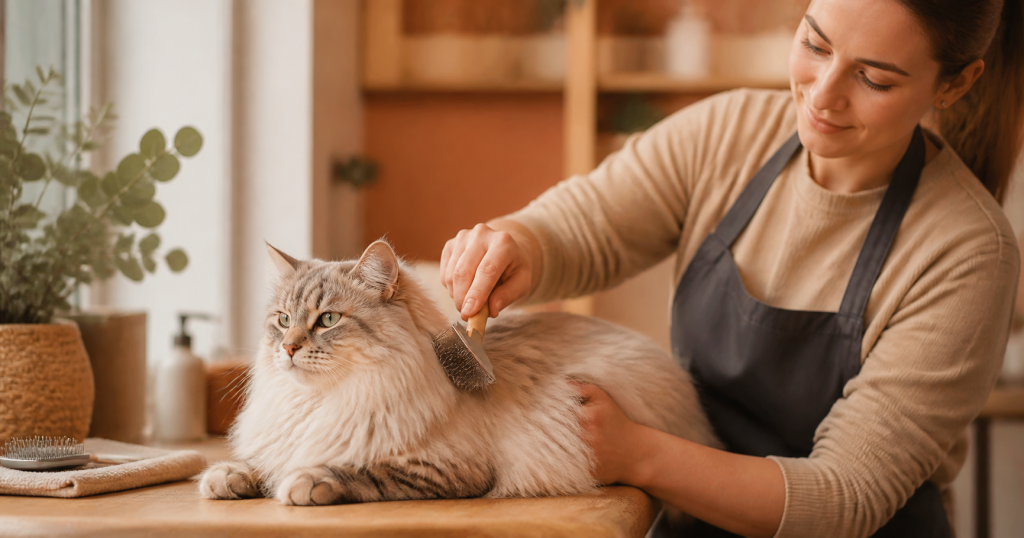
Most cats groom themselves for a good part of every day, which makes it easy to assume brushing is optional. It is not optional for every cat, and the right frequency depends mostly on coat length, age, and how your cat tolerates being handled. This guide gives you a realistic starting routine by coat type, and explains when a professional should take over.
It is written for cat owners in Chicago who want a simple home routine rather than a rule that fits every cat. Pet Care Plus is a boarding, daycare, and grooming resort, not a veterinary provider, so anything that looks like a skin or coat problem belongs with your veterinarian.
Why brushing matters even for a cat that grooms itself
A cat’s tongue removes loose hair, but some of that hair is swallowed. Brushing takes loose hair out of circulation before that happens, and it gives you a regular, hands-on look at the coat and skin. The ASPCA’s cat grooming tips note that regular brushing helps remove dirt and dead hair and spreads natural oils through the coat.
Brushing is also information. A session every few days tells you where tangles form, whether the coat feels different from last month, and how your cat responds to touch in particular areas. Those are useful things to know before a boarding stay or a veterinary visit.
A starting routine by coat length
Use these as a starting point, then adjust to your cat. A routine your cat tolerates twice a week is better than an ambitious one that ends in a scratched hand and a cat under the bed.
Short-haired cats
Once a week is a reasonable baseline. A soft bristle brush or a rubber grooming mitt handles most short coats. Work in the direction the hair grows, keep sessions short, and finish before your cat decides the session is over.
Medium and long-haired cats
The ASPCA recommends grooming long-haired indoor cats every few days to remove loose hair and help prevent tangles. Ask a professional to adapt that starting point to your cat’s coat and tolerance. Check gently for problem areas without forcing a tool through resistance. Tool choice and technique should suit the individual cat, especially around sensitive areas.
Senior cats and cats with limited mobility
An older cat may groom less thoroughly than it used to, particularly along the back and hindquarters. Brush more often, more gently, and in shorter sessions. If a cat that used to keep itself tidy has stopped, mention it to your veterinarian rather than treating it as a grooming problem alone.
Build the habit in small steps
Choose a calm time and a familiar, comfortable place. Keep the first interactions brief and stop before your cat becomes distressed. Some cats need professional help with grooming, and repeated exposure does not guarantee they will tolerate longer sessions. Ask for advice when handling is difficult rather than extending the routine because several weeks have passed.
- Let your cat sniff the brush before the first stroke.
- Start with the back and shoulders, where most cats tolerate touch.
- Leave the belly and legs until your cat is settled with the rest.
- End with something your cat likes, whether that is a treat or simply being left alone.
- Keep a note of any area where your cat consistently objects.
Tangles and mats: what to do and what not to do
A small tangle can usually be worked loose with your fingers and a comb, starting at the tip of the hair and moving toward the skin. A mat that sits tight against the skin is different. Do not cut it out with scissors. Cat skin is thin and moves easily, and the edge of a mat is hard to see. Ask a professional groomer, or your veterinarian if the skin underneath looks irritated.
If mats keep forming in the same place despite regular brushing, that is worth a conversation. It may mean the tool is not reaching the undercoat, the sessions are too far apart for that coat, or the cat is not grooming that area itself.
Bathing is rarely part of the routine
Most cats do not need regular baths. Brushing does most of the work, and a cat that gets into something sticky or unpleasant is usually a one-off situation rather than a schedule. If you do need to bathe your cat, the ASPCA suggests brushing first to remove loose hair and mats, using a product made for cats, and keeping water away from the eyes, ears, and nose.
Brushing before a boarding stay
A good brush-out before a trip is a small, practical step. It reduces the loose hair your cat carries into a new space, and it gives you a current picture of the coat to describe to the care team. If your cat is boarding at Pet Care Plus, mention any coat-care routine in your handoff notes so the team understands what is normal for your cat. The cat boarding page covers the separate, dedicated cat area and what to confirm before a stay.
For dogs in the same household, the Pet Care Plus grooming page covers full-service grooming, brush-outs, and deshedding. If you have a question about coat care for your cat, contact the team and they will point you to the right next step.
When to stop brushing and call the veterinarian
Brushing is routine care, not a way to manage a health concern. Stop and seek veterinary advice if you notice bald patches, scabs, redness, lumps, a greasy or dull coat that has changed recently, persistent dandruff, or a cat that flinches or cries when a particular area is touched. Over-grooming, where a cat licks one spot raw, also belongs with your veterinarian.
Build a routine around tolerance and coat condition
A useful brushing routine is one your cat can tolerate and you can repeat. Begin by observing when your cat normally chooses quiet contact and which areas are comfortable to touch. Do not treat an online frequency as a requirement to complete a long session regardless of your cat’s response. Coat type matters, but comfort, current condition, and professional advice also shape what is appropriate.
Keep the first aim modest: a calm interaction and a clear understanding of the tool you are using. If you are unsure whether a brush suits your cat’s coat, ask a qualified groomer or veterinarian before experimenting. A tool that works for another animal may not be a useful choice here. The goal is routine care, not a test of how much handling a cat will accept before leaving.
Learn what the tool should do before using it
Look at the product instructions and ask how the tool is intended to be used on your cat. Understand the difference between moving over the coat’s surface and checking whether a tangle remains underneath. If you cannot tell whether a tool is catching on hair or causing discomfort, stop and seek guidance rather than pressing harder.
Do not introduce several unfamiliar tools in one session. That can make it difficult to know which part your cat found uncomfortable. Keep the equipment clean and check it for damaged or rough parts. Store it where household members can identify the item intended for the cat. A grooming drawer full of unlabelled equipment is not the same as a shared, understood care routine.
Choose an ordinary place for short sessions
Use a setting where your cat can remain comfortable and move away. A quiet familiar area can make it easier to observe the cat’s response than a busy room where people repeatedly approach. Do not place the cat somewhere unstable or rely on a position you cannot maintain without restraint. If the cat consistently avoids handling, ask for professional guidance rather than improvising a stronger hold.
Keep your own expectations flexible. Some days may involve little more than a brief accepted interaction. That does not mean you should compensate with a much longer session next time. Record any recurring difficulty and discuss it with the appropriate professional. A steady routine is built around what is suitable for the individual cat, not around completing a predetermined number of strokes.
Use observations to decide what question to ask
If the coat seems different, describe what you notice: a recurring tangle in one location, a change in texture, or an area the cat no longer allows you to touch. Include when it began and whether anything else changed in the household routine. Avoid deciding that the cause must be age, weather, or temperament simply because that explanation seems familiar.
Health concerns belong with your veterinarian. A groomer may help with an ordinary coat-care question, but a new painful area or a significant change needs the appropriate assessment. Brushing should not become a way to manage a condition you do not understand. Keep the observation factual so the professional can ask useful follow-up questions.
A worked example of improving a brushing routine
Imagine that an owner brushes a long-haired cat whenever loose hair becomes noticeable on furniture. Sessions are irregular and sometimes long because the owner tries to address the entire coat at once. The cat begins leaving before the owner reaches the same difficult area. The owner initially interprets this as stubbornness and considers a stronger tool.
A more useful next step is to describe the difficulty to a professional and ask about the tool, technique, and suitable session length. The owner then follows the advice given for that cat, keeping interactions manageable and noting where a question remains. The example does not prescribe a universal schedule. It shows how observing the problem can lead to better guidance than increasing force or changing products without understanding the issue.
Coordinate the people who help with coat care
If several family members brush the cat, agree on the equipment and the advice being followed. Tell each person which areas need caution and what should prompt stopping. Avoid a situation in which everyone assumes someone else completed the routine, or several people each attempt a full session because nobody knows what already happened.
A short shared note can record the date, the part of the coat addressed, and a question to discuss. It does not need to become a detailed scoring system. Its purpose is continuity. When a professional recommends a change, replace the old instruction rather than leaving both versions in the drawer. Consistency is easier when everyone is following the same current advice.
Prepare for travel without adding a last-minute challenge
If your cat will board, explain the established coat-care routine and ask what information the resort needs. Do not assume that a boarding stay includes a particular grooming service or that staff will follow an unconfirmed home procedure. Discuss the arrangement directly. If the coat needs professional attention before travel, plan that conversation with enough time to understand the appropriate next step.
Avoid turning the evening before departure into a long, unfamiliar grooming session. Keep preparations consistent with the advice suited to your cat. Pack only the items the resort accepts, labelled clearly. A useful handoff note explains the current routine and any relevant professional guidance without asking boarding staff to diagnose a new skin or coat concern.
Keep bathing separate from the brushing decision
Finding loose hair or a tangle does not automatically mean the cat needs a bath. Ask the appropriate professional about a specific concern and use products only as directed. A new shampoo or supplement should not be introduced simply because the coat looks different in a photograph. The ASPCA guidance linked earlier provides general information; the individual cat may need a separate discussion.
If a cat gets into an unfamiliar substance, seek prompt advice about that exposure rather than attempting a routine grooming solution. Keep product information available for the professional you contact. Do not assume that a household cleaning product or a method used on a dog is suitable for the cat. The immediate question is what is appropriate for the situation, not how to complete the normal brushing schedule.
Make the next professional conversation specific
Bring a concise description of the routine, the tool used, and the difficulty you are seeing. Explain what the cat tolerates and what causes you to stop. If a photograph can be taken comfortably, it may help identify the area, but it should not replace an examination when one is needed. Do not force the cat into a position simply to obtain a better picture.
Ask what to do next, what to avoid, and how to recognize a concern that needs a different professional. Repeat the advice back if anything is unclear. A practical routine should leave you knowing which actions you can carry out at home and where your responsibility is to stop and ask for help. That understanding matters more than following a generic frequency perfectly.
Questions about brushing a cat
How often should I brush a short-haired cat?
Once a week is a reasonable starting point for most short coats. Increase to two or three times a week during seasonal shedding if your cat tolerates it.
How often should I brush a long-haired cat?
The ASPCA suggests grooming long-haired indoor cats every few days. Adapt the routine with a professional if the coat tangles, the cat struggles, or care needs change. Stop before a session becomes a struggle.
Can I cut a mat out of my cat’s fur?
Do not use scissors. Cat skin is thin and easy to nick. Work small tangles loose with a comb, and ask a professional groomer or your veterinarian about mats that sit against the skin.
Does Pet Care Plus board cats?
Yes. Pet Care Plus provides cat boarding in Chicago’s West Loop in a separate, dedicated area that is staffed 24/7. Cats need current Rabies and FVRCP vaccinations and must be free of external parasites.