
What Daycare Actually Asks of a Dog
Dog daycare gets described as though every dog secretly wants it, and that is not quite true. A daycare day asks specific things of a dog: share space with unfamiliar dogs, take direction from people who are not you, handle a noisier environment than a living room, and settle down again after being excited. Plenty of dogs find that genuinely enjoyable. Some find it like a lot of work.
The useful question is not whether daycare is good in general. It is whether your particular dog, at their current age and stage, is likely to have a good day in a supervised group setting. That is answerable from things you already see at home, on walks, and at the park, without needing a trial run to find out.
This guide walks through the signals that usually point toward daycare being a good fit, the ones that suggest waiting or choosing a different format, and how the daycare day is structured at Pet Care Plus in Chicago’s West Loop. If you want the service details first, the dog daycare page covers them.
Sign 1: Your Dog Actively Seeks Out Other Dogs
This is the clearest signal, and it is about initiation rather than tolerance. A dog who is a strong daycare candidate does not merely put up with other dogs; they move toward them. They pull gently toward a dog across the street, they choose the group over the empty corner at the park, they get visibly more animated when another dog appears.
Tolerance alone is a weaker signal. A dog who freezes, goes still, or carefully avoids eye contact around other dogs is coping, not enjoying, and a full day of coping is tiring. The difference between the two is usually obvious once you know to look for it: an interested dog has loose body movement and keeps re-engaging, while a coping dog tends to disengage the moment they are allowed to.
Age matters here too. Many dogs are most social between roughly six months and five years, and interest in group play can soften as a dog gets older. A senior who used to love the dog park and now watches from the bench has not failed at anything. They are telling you their preference has changed.
Sign 2: A Long Walk No Longer Takes the Edge Off
Physical exercise and social or mental engagement are not the same currency, and some dogs need both. If you are walking a dog for an hour and coming home to a pet who is still restless, still pacing, still looking for something to do, the missing ingredient is often not more distance. It is interaction.
This shows up commonly in city living. A West Loop or downtown dog gets structured leash walks past a lot of stimulation they are not allowed to investigate, which is not the same as being able to run, wrestle, and choose their own activity. Group play gives a dog a chance to use energy in a way a sidewalk cannot.
The tell is what the evening looks like. A dog whose needs were met on a walk settles. A dog who is physically tired but under-engaged tends to find a project: chewing, barking at hallway noise, reorganising the laundry. That pattern is often a daycare-shaped gap rather than a training problem.
Sign 3: Long Days Alone Are Getting Harder
Most dogs handle being home alone reasonably well. Some do not, and a return-to-office schedule or a change in household routine can turn a manageable six hours into a difficult ten. If your dog has started struggling with alone time, structured supervised care during the workday is one practical option worth considering.
Be specific about what you are observing rather than jumping to a label. Note whether the difficulty starts at departure or hours later, whether it is vocal or destructive, whether it happens every day or only on certain days. If a dog is showing real distress when left alone, that is a conversation to have with your veterinarian as well, since a care schedule is one part of an answer and not the whole of it.
For dogs whose issue is simply that the day is too long and too quiet, daycare tends to help quickly. The day gets broken into something with structure and company, and the dog is not holding a ten-hour shift by themselves.
Sign 4: Your Dog Recovers Well After Getting Excited
Recovery matters more than enthusiasm. A dog who gets thrilled about a visitor and then settles within a few minutes has the emotional regulation a group day requires. A dog who gets thrilled and then stays wound up for an hour will find a room full of other dogs genuinely difficult, because the resets never come.
You can observe this without any special setup. Watch what happens after the doorbell, after another dog passes the window, after a burst of play in the apartment. The question is not how high the excitement goes. It is how long the trip back down takes.
This also predicts how a dog will handle rest periods, which are a real part of a well-run daycare day rather than an afterthought. A dog who can switch off when the room quiets down gets the benefit of the whole day instead of running on adrenaline until pickup.
Sign 5: New People and New Places Are Interesting, Not Alarming
Daycare involves handling by people your dog has not met, in a building they did not choose. A dog who approaches new people with curiosity, takes food or attention from a stranger without much hesitation, and adjusts to unfamiliar rooms within a few minutes is likely to have a straightforward first day.
A dog who needs a long time to warm up to new people is not disqualified, but they will need a slower introduction and a team that is watching for it. That is worth saying out loud at intake rather than hoping it goes unnoticed, because the staff can only account for what they know about.
Pet Care Plus offers individual and special care options with spacious private suites for dogs who are shy or prefer a quieter day, so a slow-to-warm dog is not automatically pushed into the largest group. The first visit page describes how intake works.
Signs Daycare May Not Be the Right Fit Right Now
An honest list has to include the other direction. A dog who consistently guards food, toys, or space around other dogs is not a good group candidate until that has been addressed. A dog who has a history of conflict with unfamiliar dogs needs a professional conversation before a group environment, not instead of one.
Timing can also be the issue rather than temperament. A dog recovering from an injury, a dog in the middle of a big household change, a very young puppy who has not completed their vaccination series, or a senior whose stamina has dropped may all be better served by a different arrangement for now. None of that is permanent.
When group play is not the right shape, there are other paths. Professional training is available through the resort’s partner, Prestige Dog Training, and the training page has those details. Some dogs also do better with individual care options than with a full group day.
How Pet Care Plus Structures the Daycare Day
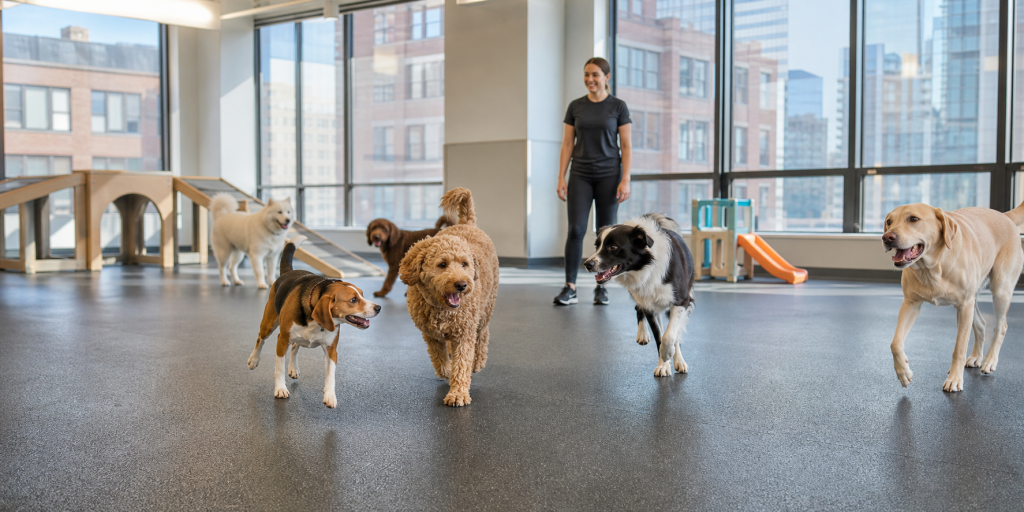
Grouping is the part that makes the difference. Pet Care Plus has a variety of play areas to accommodate all ages, sizes, and temperaments, and dogs are placed into appropriate play groups rather than combined into one crowd. A confident young Labrador and a cautious small dog should not be managing the same room, and they do not have to.
Supervision is continuous. The resort is staffed 24 hours a day, every day of the year by highly trained and passionate professionals, so there is no stretch of the day when a group is running unwatched. The building itself is purpose-built, with five air handling systems and on-site parking, which matters for both ventilation and a realistic weekday drop-off.
Daycare also includes access to the heated pool. Pet Care Plus has Chicago’s only in-ground, heated, saltwater outdoor swimming pool, at 15,000 gallons. Some dogs love it and some have no interest, and both are treated as preferences. The day in the life page walks through how a day is sequenced.
What a First Daycare Day Usually Looks Like
Expect the first day to be an assessment as much as an activity. The team is learning how your dog greets the room, which group suits them, how they handle transitions, and when they need a break. Sharing what you know at drop-off makes that faster and more accurate.
Most dogs come home noticeably tired after a first full day, which is normal. What is worth paying attention to is the shape of that tiredness. A dog who is content, settles easily, eats normally, and is ready to go back is a good sign. A dog who comes home wired, unable to settle, or reluctant at the door next time is telling you something about pace or group fit that is worth raising with the team.
Puppies get a more specific path, since early supervised exposure to other dogs is a different project from adult group play. The puppy socialization program is built around that difference.
Vaccinations, Hours, and Booking
Pet Care Plus requires current vaccinations for daycare and boarding guests: rabies, the distemper combination (DHPP), and Bordetella. Proof is required, so request records from your veterinary office ahead of the booking date rather than on the morning of drop-off. The requirements and vaccinations page has the current list.
Drop-off and pick-up run Monday through Friday from 6:45 a.m. to 7:00 p.m., Saturday from 9:00 a.m. to 4:00 p.m., and Sunday from 10:00 a.m. to 3:00 p.m. Extended early drop-off is available on weekday mornings from 6:00 a.m. and Saturday from 7:00 a.m., and extended late pick-up runs to 9:00 p.m. daily, with a $7 per-dog fee for late pick-up.
Booking is primarily online through the Book Now page, with separate paths for new and returning customers, and by phone at (312) 397-9077. New customers get a first day of play free, or a first night of boarding, with exclusions applying. Pet Care Plus also offers in-person tours by appointment and keeps an open door policy, so you can see the resort before committing to a day.
For broader guidance on evaluating any daycare or boarding setting, the American Veterinary Medical Association pet owner resources are a useful outside reference.
FAQs
How do I know if my dog is right for daycare?
The strongest signal is a dog who actively seeks out other dogs rather than merely tolerating them, recovers quickly after getting excited, and adjusts to new people and places without much hesitation.
Is daycare a good idea for a dog who struggles alone all day?
It can help when the issue is a long, quiet day. If a dog shows real distress when left alone, discuss it with your veterinarian as well, since a care schedule is only part of the answer.
How does Pet Care Plus group dogs in daycare?
The resort has a variety of play areas to accommodate all ages, sizes, and temperaments, and dogs are placed into appropriate play groups rather than one combined crowd.
What vaccines does my dog need for daycare?
Pet Care Plus requires current rabies, distemper combination (DHPP), and Bordetella vaccinations, with proof provided before the first day.
What if my dog is shy or slow to warm up?
Shy dogs are not automatically placed in the largest group. Pet Care Plus offers individual and special care options with spacious private suites, and it helps to flag it at intake.
What should I expect after my dog's first daycare day?
Most dogs come home noticeably tired and settle easily. If a dog comes home unable to settle or is reluctant to return, raise the pace and group fit with the care team.
Conclusion
Most of the signs that a dog would enjoy daycare are already visible at home: who they move toward, how they come down from excitement, and what the evening looks like after a long walk. If those point toward group play, a structured supervised day is usually a good fit, and if they point the other way, that is worth respecting rather than pushing through. For Chicago pet parents ready to try it, review the daycare details, gather current vaccination records, and book a first day of play.